
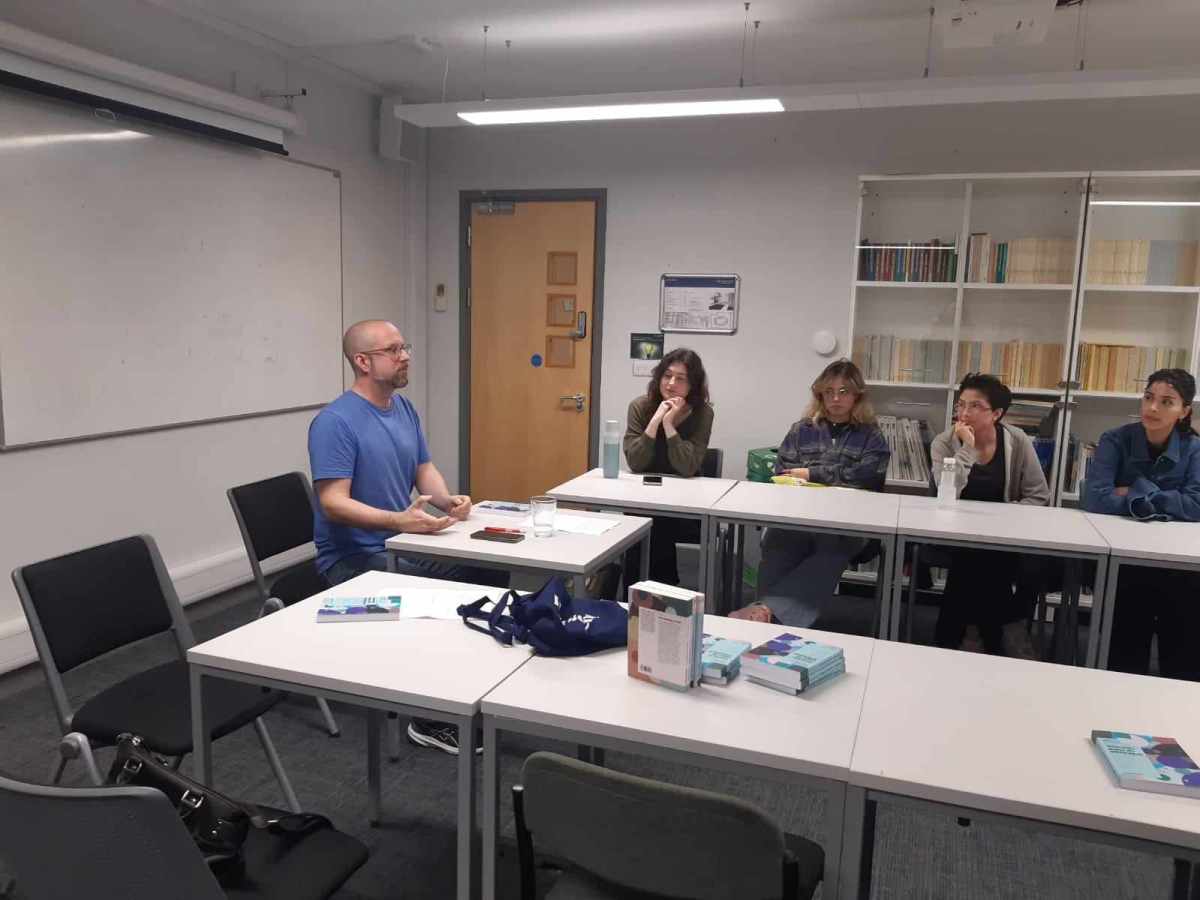
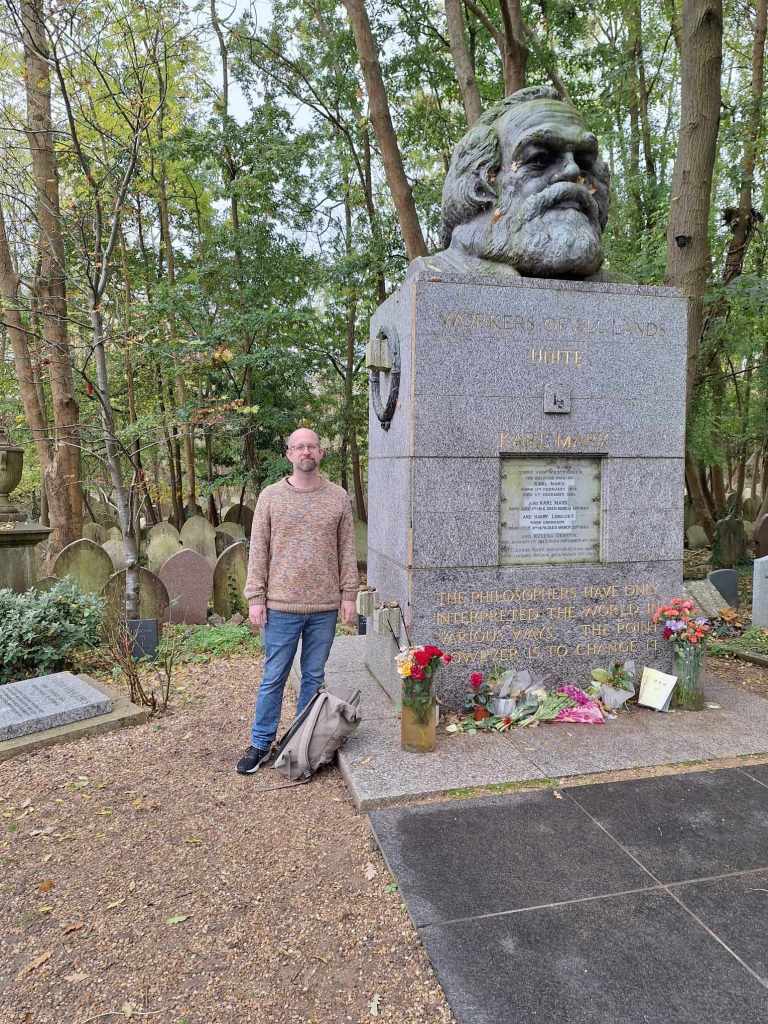
Auf Einladung von der Queen Mary University of London durfte ich für das Insitut für Modern Languages and Cultures unser neues Buch „Gespräche gegen die Wirklichkeit“ vorstellen. Danke nochmal an Ana Ilic, die das möglich gemacht hat, die sich rührend um mich gekümmert hat und mit mir den langen Marsch nach Highgate angetreten ist, was ein wunderbarer Ausflug war.
Das die Wirklichkeit sich überaus effizient gegen ihre Kritiker zu verteidigen weiß, lernten wir 10 Minuten vor Veranstaltungsbeginn, als uns klar wurde, dass die Ankündigung des Vortrags aufgrund eines Übertragungsfehlers „Gespräche ÜBER die Wirklichkeit“ lautete. Well played Wirklichkeit, well played.
Ich habe mein Textmanuskript hier abgebildet. Die Profs vor Ort waren sehr freundlich mit mir und ich hatte Ana als Hilfe bei der Diskussion. Aber mir ist bewusst, dass mein Englisch nicht the yellow from the egg ist.
Conversations against reality
The scary space of consumption
Please don´t be too strict, when judging my English skills. I am a native german speaker. More precisely, to quote a famous singer/songwriter from my country who had some problems with cocaine, but gave Austria its unofficial hymn, that you hear when you land on an Austrian Airways machine: “I am from Austria.” So …
A few years ago, Mark Fisher, who sadly sadly passed away in 2017, described the sentiment of our everyday life as the “call center experience”.
That we are all consumers is a common statement, but that the space of consumption is the opposite of a space full of possibilities is an oppressive experience. In reality, the consumption sphere is actually very limited. Everyone experiences the limits of product availability, and the customer service at some point. And then we get to experience the complete absence of attributable responsibility, the complete lack of ways out of the dead ends and the total lack of prospects in an endless loop, when it comes to the simplest problems.
For Fisher, this scary experience is the “systematic consequence” of capitalist logic. The exploitation of value, driven by the laws of accumulation, means that production is not carried out in order to satisfy our needs, but rather within the framework of a calculation that is as alien to human sentiment as a nation of alien conquerors. The world is arranged in such a way that the economic surrogates of variety and richness can only be obtained at the price of programming consumers to allow simplicity to be sold as diversity to them.
It sounds like a dystopia, when Fisher writes that at the edge of the consumer sphere a “world without memory, in which cause and effect are unfathomably connected, in which it is a miracle if anything ever happens where you lose hope of ever finding a solution to your own concerns” awaits us. It sounds dystopian when he describes a system that appears to us to be impersonal, abstractly fragmented and unavoidable and at the same time gives us the impression of being absolutely efficient and almost infallible. Everything can be bought, everything has its price, everything is always available, everything runs legally and yet is always dangerously close to complete collapse: your own! Not that of the system, because the system lives off the exploitation of individuals until their collapse. Division of labour, professional roles and abstract management has led to the exchangeability of everyone. The best worker can be replaced sooner or later, by a surrogate fulfilling its role in the interest of exploitation.
Anyone searching for an undelivered package will end up in the labyrinth of the capital and experience the exchangeability from the customer side who shares the same fate. Since in most cases a missing package remains missing, even if the supplier admits to having messed the delivery up himself, the effort required to find it is too great. It will be replaced with another identical product. For free, if you are lucky. At your own expense, if the seller isn’t also exploited by Amazon. A look behind the facade of consumption and into the delivery processes, the cost-cutting constraints of customer service and the entanglements of the supply system leads into a dark tunnel. The dullness of conditions results from the constraints of daily repeating routines. The daily labour, that is forced on the individual, takes up the resources that would be necessary for creative development, and is instead spent on recreation, in order to maintain everyday working life. We have to stay in the most uncomfortable positions for years, because we are too tired to think about how we can change our posture. Call center experience means: We sit on hold, because we have no other choice.
Capitalist Realism
Mark Fisher calls the design of this mousetrap “capitalist realism”: “It’s easier to imagine the end of the world than the end of capitalism”. He illustrates this by taking the example of Kurt Cobain and his band Nirvana.
“Cobain knew that he was just another piece of spectacle, that nothing runs better on MTV than a protest against MTV; knew that his every move was a cliché scripted in advance, knew that even realizing it is a cliché.” It’s the cultural industry stupid!
This can also be applied to (academic) social criticism: “As long as we believe that capitalism is bad, we are free to continue to participate in capitalist exchange.”
Markus Metz and Georg Seeßlen go even further: they see a capitalist surrealism. Not in contrast to Mark Fisher, but in a hidden reference to him. Surrealism as a form of enhancement: “Neoliberalism not only produces economic crises, wars and financial market crashes – it also changes the cultural and political order. Capitalist surrealism arises when watching a capitalist-realist who finds the system reasonable and sees critics of the system as romantics; who scoffs at ‘do-gooders’ but is also happy to donate when a pop star calls to save the rainforest.”
They write: “The narrative style of capitalist surrealism is ‘noir’. Like the hardboiled crime novel or film noir, it is about autonomous, sarcastic and injured people in an irredeemable world, in a world that, more precisely, can only be hell. This is also completely clear to the individual representative of capitalist surrealism: that he is not in a paradise, not even in the vale of tears of a worldly reality (the delayed reward), but quite directly and literally in hell. And if capitalism is not nature but hell, opposition and alternatives become no less obsolete. The number of those who have freed themselves from hell is very, very limited. The image of hell for capitalism is therefore almost more compelling than the image of ‘nature’. If we are all in hell, it is not wrong to make pacts with the devils”.
Consequentially Metz and Seeßlen claim a relationship between financial management and pop culture. The new realism is based on identification with capitalism. The new surrealism maintains this relationship through aesthetics, as the ultimate legitimation. Capitalism in its current form stays alive, because it makes itself “nonsensical, invisible and untouchable” as financial capital and “ubiquitous, iconic and endlessly approachable” as an aesthetic event. Iconography of the brands, the TechBillionairs, the designer fashion, the fitness and diet trends …
How to break free?
Answers to this plight could be found, but they cannot be limited to further academic publications or capricious technical discussions. In everyday life we are already surrounded by the constraints of necessity, and the endless production of expert knowledge only reproduces this compulsory structure in the form of ever new prisons of text and knowledge. The idea comes to mind that we are constantly being taken by the hand by the narratives of instrumental action. Under the conditions of traditional reproduction of knowledge, any attempt to escape is pointless.
However, if we do come to the conclusion that an outbreak is necessary, then it would have to take a completely new form. Politically, as mole work, the silent collection of accusations against the system of exploitation and the spreading of rumors about possible escape routes. The italian anarchist Johannes Agnoli speaks of self-knowledge and self-organization of the “negative potential”. Those excluded and exploited by the system should start conversations about their struggles and through this exchange organize not only resistance, but alliances to counter the monopolies of coercion on the side of capitalist structures.
This new form is actually derived from a very old form. Not only is “negative societal potential” a term prominently used by Hegel. The subversive tactics of conversation itself stand at the beginning of resistant thinking. The work of the art of dialogue is a means of the weak against domination, because it makes the speakers recognizable. After an open dialogue there are no more excuses, no ideological subterfuges. But this is not about a discourse free of coercion or about deliberation. Habermas‘ discourse ethics is a violation of open dialogue, of the art of conversation, which by nature cannot follow any ethics, other than the production of critical knowledge about domination and coercion.
This form of conversation has a long philosophical tradition and an equally long history of its oppression by governments. Plato’s dialogues create an opportunity to identify with Socrates‘ ideas. They are designed to help people think for themselves. The Socratic tradition asks about what is supposedly self-evident and encourages us to question it. Looking under the surface of reality reveals the immune system of the ideologies of power. Socrates is ready to die for his dialogical defiance of the authorities and ends his life with poison. Not very much unlike Mark Fisher who ended his life, in the face of an unresponding system, that negated effective help for a critical mind with crippling depression.
Another example is Oscar Wilde. He died subsequently to his imprisonment after a juridical fight with a nobleman. Not because he questioned the connection between social reality and aesthetic construction in his dialogues “The Decay of Lies” and “The Critic as Artist,” but because he, a homosexual, violated the rules of a reactionary society.
The still living filmmaker Alexander Kluge has had a multitude of conversations with countless partners, that can be used as resources to start your own critical thinking. At 92 he is still present in film and TV today and assists the mole work of self-knowledge and self-organization. He even made a a film about Capital: “News from ideological antiquity”, and the financial crisis: “fruits of trust”. Both films consist of plenty critically rich conversations to mobilize the viewers fantasy against the forces of realism.
A book as a conversation
In this book series we view conversation as a method of criticism, developed through free association and as an aesthetic resistance to the reproduction of culture and knowledge. Our conversations are criticism of dominant realist ideology, and political intervention against the conditions of cultural reproduction. Our book contains conversations, and at the same time, following the motto of Jorge Louis Borges: “Reading is thinking with another’s brain”, is a conversation with the reader.
In the introduction we treat the political economy of social power relations and the related political morale, which has now become a purely aesthetic and identitarian moralism. A moralism that immunizes itself through economic facts.
The conversations we gathered afterwards deal with work, the cultural industry and sexual practice and identity. In it we attempt to work out the exploitation of value and the self-utilization of individuals, and to pick them apart through dialogue, by pointing out that this constellation of work, the cultural industry and sex does not serve to satisfy the needs of individuals, but rather serves the exploitational interests of capital. Parallel to capitalist realism, the lazy magic of identitarian socialization is a cage for the integration of individuals into the “Kapitalverhältnis”. They are not meant to receive what they need to make their lives fulfilling and satisfying, they should rather satisfy the system and live for the interests of their identity. They should follow the label of their existence, as workers, consumers and people with certain sexual preferences, throughout their lives and function in these roles. Furthermore, they should keep their mouths shut and certainly not think for themselves.
Work serves as a tyrannical machine to prevent self-development, self-perception and self-determination. A diffusion mechanism for dispersion and distraction, similar to the culture industry, which has to serve as a “Haupt- und Staatsaktion” to demobilize creative energies. The package of measures to maintain the “Kapitalverhältnis” is closed by sexual racketeering, that depends on the methods of categorizing, clarifying, measuring and constantly discussing sexuality in empty phrases, academic lectures and NOT dialogues, advances the trivialization of sexual relationships and at the same time normalizes the outrage of reactionary rackets against free sexuality.
We counter this with a production of imagination and knowledge that is deliberately excessive. An unsystematic collection of resources for free use. To create an incentive system to think for yourself. To build on the countless topics we raise and get an impression of what it feels like to think with someone else’s brain. Our book is an offer for the creative use of one’s own knowledge in order to identify coercion and to learn to understand and dismantle it from one’s own perspective. A reading for a long winter. Until when? We don’t know.
 halbwertszeit